Cordless stick against upright
Quick answer
The Dyson V11 Origin ($449.99) is a cordless stick rated at 185 air watts with a 60 minute eco runtime, built for quick, battery-powered convenience. The Dyson Ball Animal 3 Extra ($549.99) is a corded upright with no runtime limit, built around a full-size motor driving the brush roll for deeper carpet agitation. Cordless wins on convenience and gets used more often; corded uprights generally clean carpet more thoroughly per pass because the motor never has to ration battery power.
Published manufacturer specifications, plus general vacuum servicing and category conventions where noted.
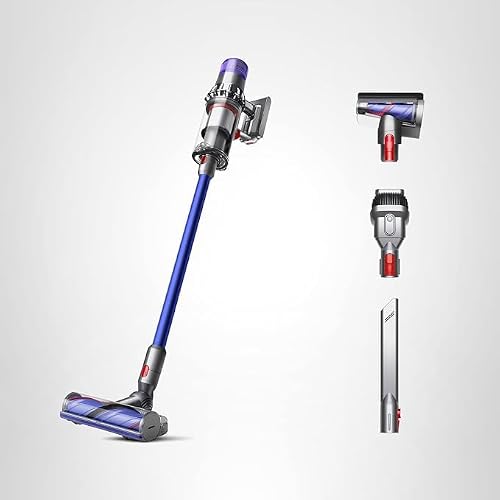
Dyson V11 Origin Cordless Vacuum, 185AW, 3 Power Modes, Up to 60 Minutes,² Deep Cleans Hard Floors and Carpets, Detangles pet Hair, Converts to Handheld
Most households vacuum more often, and more thoroughly over a month, with a machine they don't have to plug in and unwind a cord for every time. The cordless stick trades some peak carpet performance for a format that actually gets used daily, which tends to matter more for total floor cleanliness than a single deeper pass once a week with the upright.
The two sides
- Cordless stick (Dyson V11 Origin)
Rated at 185 air watts with a 60 minute eco runtime and no cord to manage.
$449.99 Check pricePrices change often - Upright (Dyson Ball Animal 3 Extra)
Dyson Ball Animal 3 Extra Corded Vacuum
A corded upright with a full-size motor that drives the brush roll continuously without battery rationing.
$549.99 Check pricePrices change often

| Factor | Cordless stick (Dyson V11 Origin) | Upright (Dyson Ball Animal 3 Extra) |
|---|---|---|
| Price | $449.99 | $549.99 |
| Power source | Battery, 185 air watts rated | Corded, mains powered |
| Rated runtime | 60 minutes (eco mode) | No runtime limit while plugged in |
| Carpet agitation power | Limited by battery draw | Full-size motor drives brush roll continuously |
| Typical service life | 4 to 7 years | 6 to 10 years |
| Best suited for | Quick daily pickups, stairs, tight spaces | Deep weekly carpet cleaning, whole-house sessions |
Carpet cleaning is about agitation, not just suction
Carpet fibers hold dirt down in the pile, and the tool that actually lifts it out is a driven brush roll working against the fiber, not suction pressure alone. Uprights put a full-size motor directly behind the brush roll and run it continuously from wall power, so the brush never slows down to conserve a battery. Cordless sticks run the same kind of brush roll, but the motor and brush draw from the same limited battery, so most cordless sticks temper brush speed or runtime to avoid draining the pack too fast on carpet.
That difference is a design tradeoff, not a defect in either format. It means an upright will generally out-clean a cordless stick on the same patch of thick carpet pile in a single pass, largely because it isn't managing a power budget.
Why cordless still wins in practice for most households
A vacuum that has to be plugged in, unwound, and re-wound after every use gets pulled out less often than one that's already sitting charged by the door. Convenience compounds: a cordless stick used for five minutes daily will often keep floors cleaner over a month than an upright used once a week, even though the upright cleans harder per session. This is a real-world usage pattern, not a claim about either machine's raw performance.
Battery limits versus motor limits
The Dyson V11 Origin is rated at 185 air watts in eco mode with a 60 minute runtime; boost mode draws down the battery roughly three to four times faster in exchange for more power at the head. A corded upright has no equivalent tradeoff, since it draws directly from household power and never needs to throttle for battery life. That is the core mechanical reason uprights remain the standard recommendation for heavy carpet households, while cordless sticks dominate for hard floors, stairs and quick pickups.
A question people actually ask: can a cordless stick fully replace an upright?
For many single-level homes with mostly hard flooring and light area rugs, yes. For homes with wall-to-wall carpet, deep pile, or heavy pet shedding, a corded upright's uninterrupted motor power generally handles that specific job better in a single pass. Many households end up keeping both: a cordless stick for daily maintenance and an upright for a weekly deep pass on carpet.
- Hard floors and light rugs: a cordless stick is usually sufficient on its own.
- Wall-to-wall carpet or heavy shedding: a corded upright's continuous motor power tends to lift more embedded debris per pass.
- Stairs and upholstery: cordless sticks convert to handheld mode more easily than most uprights.
Pick a cordless stick like the Dyson V11 Origin if your home is mostly hard floors and light rugs, or if you value being able to grab it and go without unwinding a cord. Pick a corded upright like the Dyson Ball Animal 3 Extra if you have wall-to-wall carpet, heavy pet shedding, or want a single machine with no runtime ceiling for long whole-house sessions. Many households genuinely benefit from owning one of each rather than treating this as an either-or choice.
Others in this category
An even spread across the price range.
- Bissell
Bissell CleanView Compact, Powerful Suction & Extension Wand, 3508
$59.01 Check pricePrices change often - Kenmore
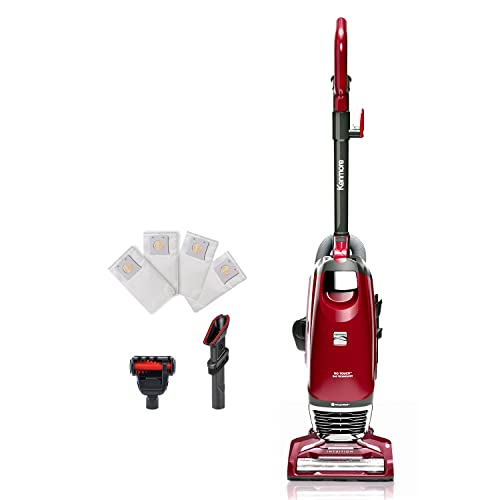
Kenmore Intuition Bagged Upright Vacuum Cleaner Lightweight
$129.99 Check pricePrices change often - Levoit
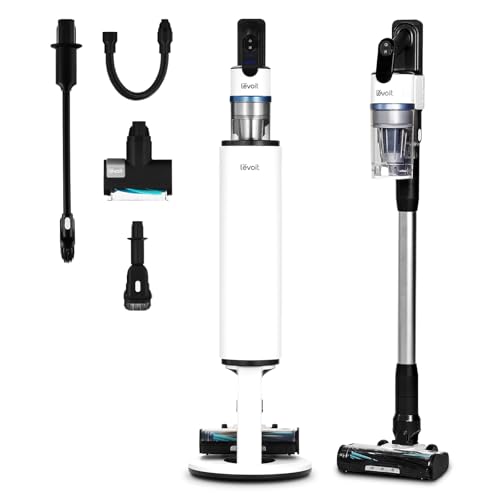
LEVOIT AERO™ Cordless Vacuum, Auto-Empty Station, Up to 70 Minutes, Premium
$299.98 Check pricePrices change often




Common questions
Does a cordless stick vacuum really clean carpet worse than an upright?
Not necessarily worse overall, but a corded upright's full-size motor drives its brush roll continuously without rationing battery power, which generally gives it an edge on a single deep pass through thick carpet pile. A cordless stick can still clean the same carpet effectively with more frequent, shorter passes.
What does the 185 air watt rating on the Dyson V11 Origin actually measure?
Air watts combine airflow and suction pressure measured at the cleaning head, giving a picture of real working power rather than suction alone. It cannot be compared directly to a pascal rating from another machine, since the two use different measurement methods.
Why does the corded upright have no runtime limit?
It draws power directly from a wall outlet rather than a battery, so there is no charge to deplete during a cleaning session. The tradeoff is the cord itself, which limits reach and requires unplugging and replugging between rooms.
Which format lasts longer before it needs replacing?
Corded uprights typically last 6 to 10 years since they have no battery to degrade, while cordless sticks typically last 4 to 7 years as their battery capacity fades with charge cycles over time.
Is it worth owning both a cordless stick and an upright?
For homes with a mix of hard floors and wall-to-wall carpet, many households do keep both: a cordless stick for daily quick cleaning and an upright for a deeper weekly pass on carpet. It is a reasonable setup rather than a sign either machine is inadequate on its own.
Does boost mode on a cordless stick match an upright's cleaning power?
Boost mode increases air watts substantially over eco mode, but it also drains the battery roughly three to four times faster, so it can only be used in short bursts rather than for a full whole-house session the way a corded upright can run continuously.
Every figure here comes from published manufacturer specifications, owner reported measurements and repair documentation, and each is labelled as either a standard or a convention. This is researched general information to help you diagnose and plan, not professional advice, and it cannot tell you what is wrong with one particular machine. Your own manual and the part number printed on your machine are the final word.